Lubumbashi - A City That Tests Your Patience
A personal, deeply researched account of living in Lubumbashi, DRC for a few weeks — housing, transportation, road safety, restaurants, consumer rights, and what other African cities have already solved better.
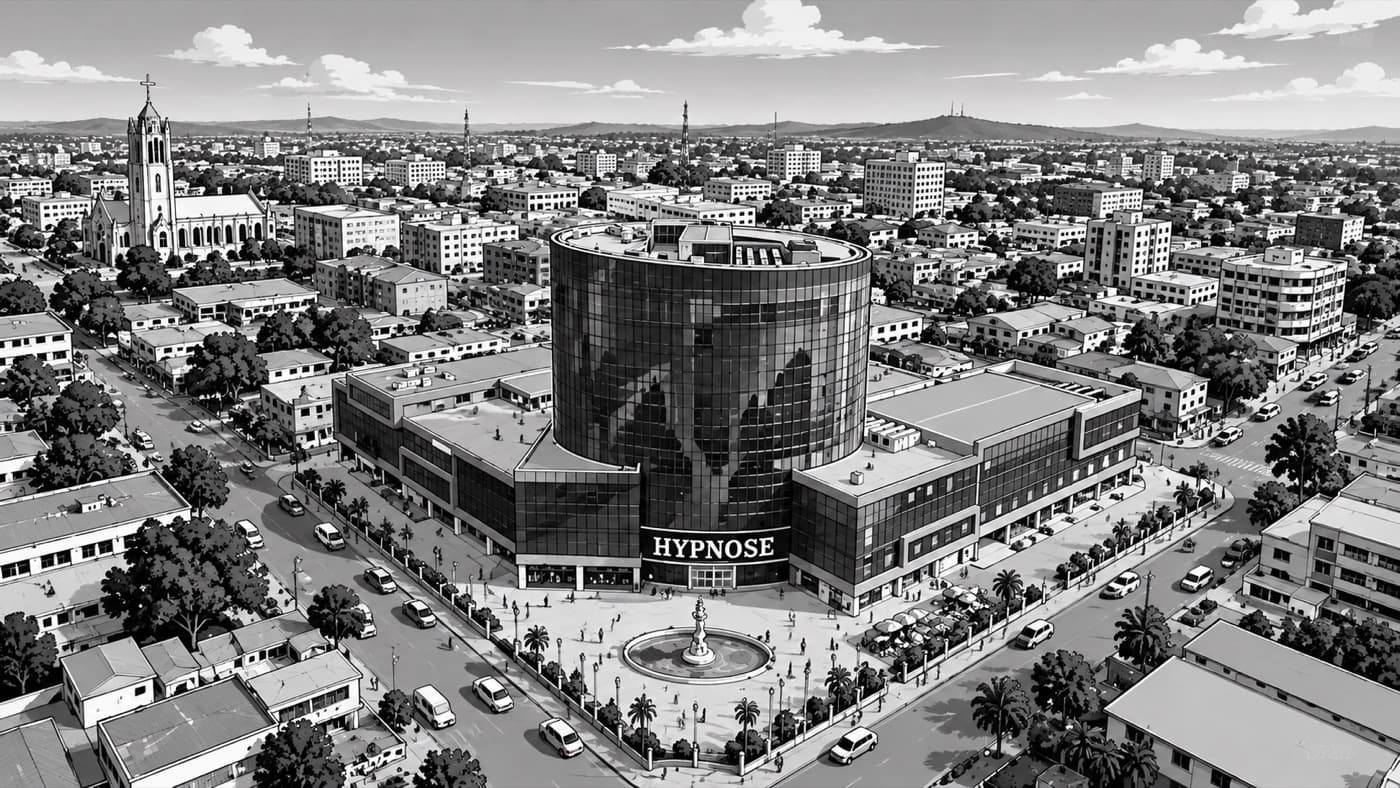
Reflections from a Congolese who thought he already knew his own country
Fair warning: this is gonna be a long read
Grab a coffee... or, if you're already in Lubumbashi, maybe order one now - you'll probably finish reading before it arrives 🙂
This is a little different from my usual technical articles ... After spending a few days actually living in Lubumbashi instead of simply visiting, I ended up taking faaaaar more notes than I expected. Some are compliments, a lot are frustration, and some are simply ideas
If you love Lubumbashi, I hope you'll read this with the same spirit in which it was written: affection, honesty, and optimism
Introduction
For context, I'm Congolese, so I am not particularly happy exposing the bad side of our reality.
I was born and raised in Goma, have lived in Kinshasa, and over the years I've been fortunate enough to travel to several countries and modern cities. Lubumbashi isn't new to me either - I had visited a few times before (2022 and 2024). But like many visitors, my experience had always been limited to a few days: a hotel, a few meetings, some good food, foreigners' restaurants, and a flight back home.
Living somewhere, even for a short period, is a completely new experience. You stop seeing a city as a destination and start experiencing it as a system: you need reliable internet, somewhere decent to live and eat, transportation you can trust, working payments, and services that respect your time and money.
After only a few days in Lubumbashi, I realized that what surprised me wasn't one major problem. It was the accumulation of dozens of very small ones. None of them are catastrophic on their own. Together, however, they quietly make everyday life much harder than it needs to be.
Most of what I'm about to describe isn't unique to Lubumbashi; many Congolese and African cities face similar problems. Kinshasa, for example, sometimes experiences them on an even larger scale. I'm using Lubumbashi as the case study because it's the city I've recently experienced as a resident rather than as a tourist.
This article isn't meant to criticize a city. It's meant to ask a simple question:
Why are so many ordinary things unnecessarily difficult?
1. First Impressions
I don't think I have to say this, but … is this an international airport? Don't forget travelers pay the GoPass tax on every flight. This is exactly the question I had to ask myself; unfortunately, it was. I just landed in Lubumbashi. The following image shows what I first saw; far from believing it, this is actually the airport of one of the major cities in Congo.
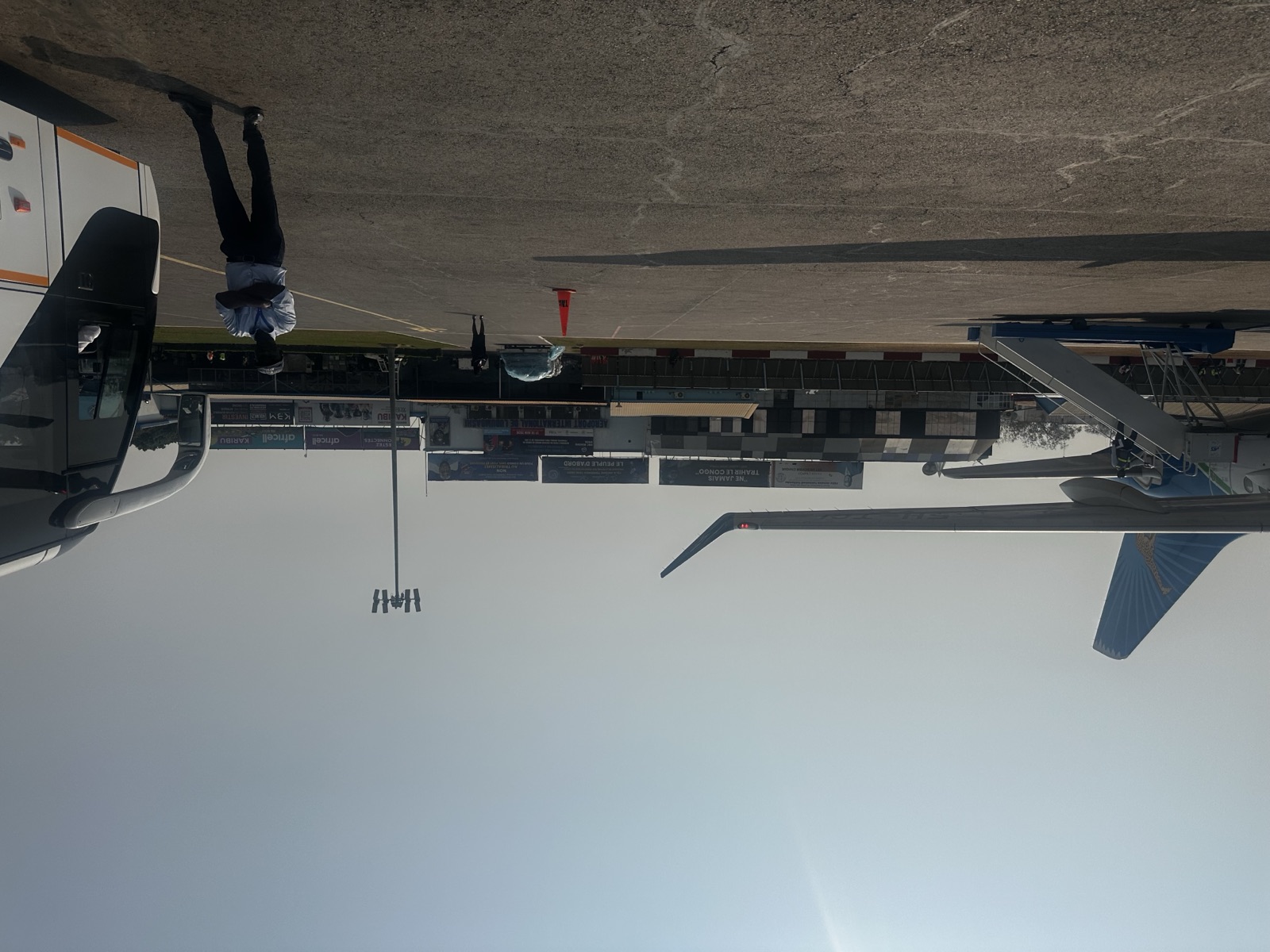
After stamping my passport, I had to collect my luggage; you should see the baggage carousel section of the airport. Dark as hell, loaded with people (not passengers), people gently asking to "help you find your luggage"; I mean, I don't need help; I can "find" it myself …
Many other frustrating situations: they scan your luggage twice because they're not sure they already did; toilets were "under maintenance" 😃; officers ask for money for no reason (this is common in many African airports, anyway - even in Kenya); ATM were out of service … Quick note: you better come with your cash in hand, please.
Luckily, I had friends who already organized my transportation going "home", so I didn't have to struggle with it.
Another impression was how easy it seemed for newcomers to be overcharged. The lack of organisation and clear pricing makes that much easier. If you are not familiar with prices, you can easily pay $50 for a 5km ride (there is no Uber or Bolt; Yango exists, but we'll talk about it later) or buy a 2Go internet bundle for 5$, and many other services can cost 10x their habitual price, because you are at the airport 🙃.
First thing to note? We can do better, organise our airports better, have better public services, and this won't cost millions - just a little goodwill and some serious punishment toward non-compliant people.
2. Finding a Place to Live
I knew beforehand that finding a place to live would be a challenge, applications like Booking.com or Airbnb don't quite work there. Almost, because a few properties are listed, but based on my experience with Kinshasa's hosts (they list a property with specs they don't have, or pictures that are 5 years old), I decided to use a different approach this time: contact a few local brokers, ask for pictures of the property, send a friend to visit the place, then agree on the price.
So I had to contact almost a dozen of them - this was like 3 weeks before I came. Before yelling at me, here are a few brokers I contacted:
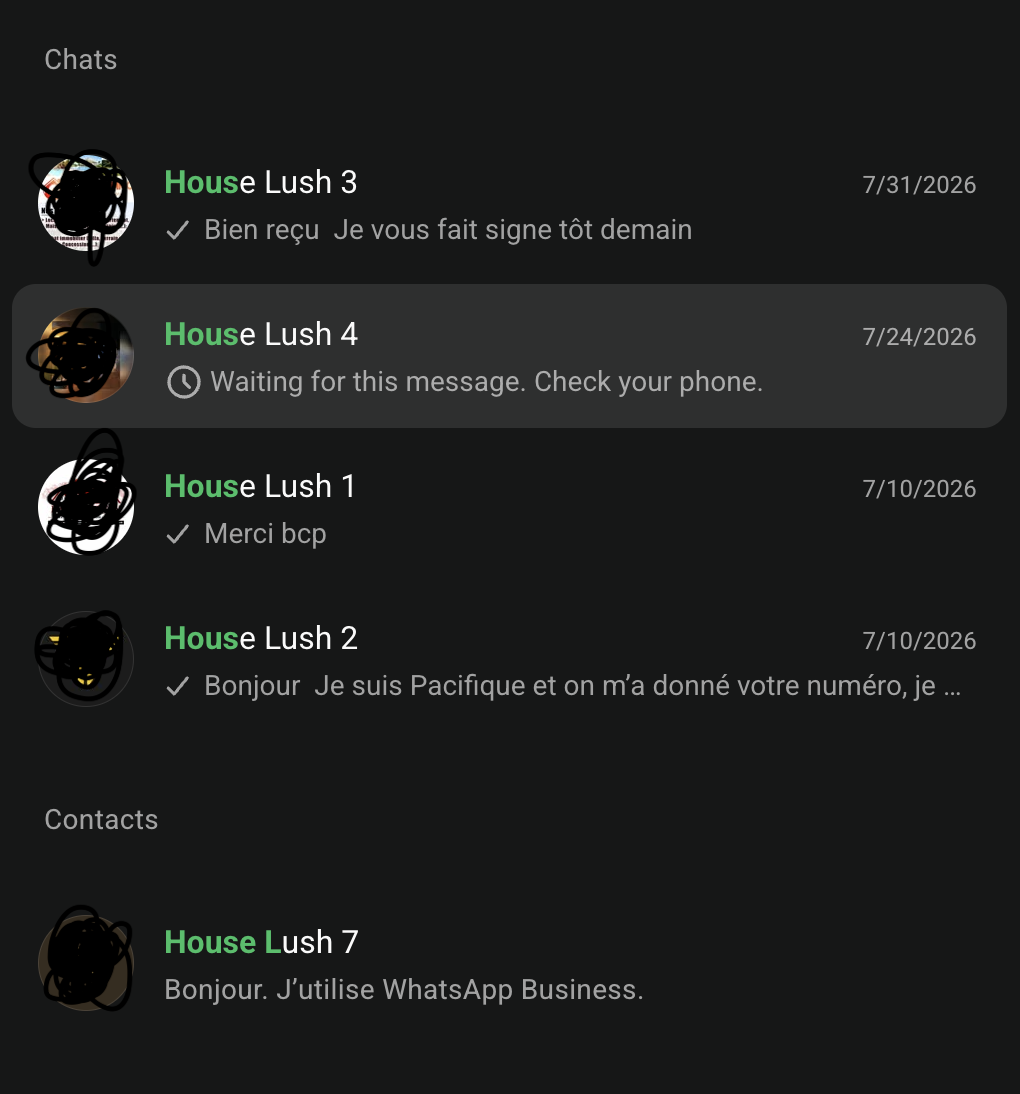
From my interactions with a few brokers and property owners, I came to a rather frustrating conclusion: Lushois aren't particularly great at providing services.
Sometimes, I genuinely felt like I had to beg someone to respond to me. And I kept thinking: I am literally trying to give you my money... come on …
At first, I thought this was just a broker problem. Maybe I had simply come across a few difficult ones. But after dealing with different people and different services, I started realizing that what I was experiencing might be less about individual people and more about a certain culture of doing business.
The word that kept coming to mind was nonchalance.
There is a strange lack of urgency when it comes to serving a potential customer. You can be ready to pay, ready to visit a property, ready to move in; and somehow, you are the one chasing the person who is supposed to be selling or renting something to you.
And sometimes, they will simply turn you down.
Not because the property is unavailable. Not because you offered too little.
Just... no. Maybe too tired to deal with a client that specific day
That was probably one of the hardest things for me to understand.
"Like, do you actually want to make some money or what?" 😂
The renting experience itself doesn't help
Finding a property isn't simply about finding something you like and paying for it.
You actually have to go through a broker, pay a visiting fee, receive information that turns out to be inaccurate, travel to the property only to discover that the reality is different from what you were told, and sometimes arrive to find out that the owner has a completely different price or set of conditions.
And because most of the process happens informally, there isn't always a simple way to know whether the information you're receiving is accurate
This is one area where I think technology could remove an incredible amount of friction.
Imagine a proper platform where landlords could list their properties directly:
- Verified property ownership
- Accurate photos and descriptions
- Exact location
- Monthly price
- Availability
- Furnished/unfurnished status
- Utilities and additional costs
- Contact information
- Reviews or verification history
Something like Airbnb, but adapted to the local long-stay rental market.
The point wouldn't be to eliminate brokers completely. Good brokers can still provide real value. The point would be to democratize access to the market so that a landlord doesn't have to depend entirely on someone's personal network to find a tenant.
A property owner in Lubumbashi should be able to list their property once and potentially reach someone arriving from anywhere in the world, without that person having to know someone who knows someone.
And for the tenant, the experience should be simple:
Search → Compare → Visit → Decide → Pay.
Not:
Ask around → Call a broker → Wait for a response → Call a few other brokers → Pay visiting fees → Discover the information was wrong → Call another broker → Repeat → Until someday you are lucky
The technology isn't the difficult part. The real challenge is building trust, verification, and a culture of good service around it.
Then you actually have to live there
Getting the keys is one thing. Actually living there is another.
Electricity was one of the first challenges. During the rental process, I was told the house had alternative power suppliers and solar panels. Once we moved in, we quickly discovered that some of those promises were... optimistic if not false 🙃
The house had an electric cooker, but with unreliable electricity, cooking became a daily problem. We asked about installing a gas cooker, but the answer was no 😅 the owner was afraid someone could misuse it and burn the house. Fair concern, I guess, but we're in big 2026. Surely there are safer ways to manage a gas cooker than making people completely dependent on unreliable electricity.
And then there were the usual smaller things that didn't work properly. Eventually, I just started improvising and fixing whatever I could with whatever I had.
Again, the pattern was familiar:
You don't necessarily get the service you were promised. You get good at finding workarounds and "we" call it being resilient … 🙃
3. Transportation, Roads & PCR: moving around shouldn't be this hard - or dangerous
Transportation was probably the part of my stay that made me the most uncomfortable.
Not because getting from point A to point B is impossible, but because I never felt completely sure I would arrive safely. Almost every day I had to use public transportation, I had this thought somewhere in the back of my mind:
"I hope this isn't my last ride"
Maybe that's dramatic, i get it. But when you're sitting in a vehicle where overtaking, avoiding potholes, motorcycles, and Petitas(1) all happen simultaneously, you quickly realize how little control you have over your own safety.
And the roads don't exactly help.
There are potholes everywhere, sometimes large enough to force an entire vehicle into the opposite lane.
And then, there is the other option: "Fine, I'll rent a car and drive myself"
Which comes with another layer of complexity. From the vehicles I encountered, it seemed that a surprisingly large number were operating with missing or questionable documents. I don't have reliable data to claim a specific percentage, so I'll leave that as my personal observation rather than a statistic. I had to avoid fighting with PCRs every day, even though I could drive fine tonight or during weekend, because they don't arrest people when offices are closed 😃.
What I can definitely say is that there are a lot of roadside controls, and 0 roadside signals.
You can have insurance, registration, technical inspection, various taxes, and other documents (I even encountered one I wasn't familiar with: Stationnement), and still find yourself repeatedly stopped and asked to produce them, and they find a way to get some money from you, like always!
I'm not against controls. A functioning transport system needs them. But I can't help asking:
How many taxes and fees are we paying to maintain our roads, and what are we actually getting in return?
If citizens are required to pay for roads and vehicles, shouldn't they reasonably expect roads with proper markings, functioning signs, regular maintenance, and basic safety?
And this is where I think some improvements don't necessarily require millions of dollars.
Paint the roads. Put up signs. Repair the potholes. Enforce speed limits. Clearly indicate where overtaking is prohibited.
These are relatively simple interventions, but they change how people behave.
A good road doesn't just move cars. It tells drivers what to do.
When the infrastructure communicates nothing, everyone improvises, fairly - and sometimes those improvisations can cost lives. I am pretty sure they do cost lives 👀
I couldn't find reliable statistics specifically connecting potholes and these particular overtaking situations to deaths in Lubumbashi. But after experiencing one myself, I couldn't help wondering how many people have already paid the ultimate price for the same kind of situation.
4. Road safety by numbers
One thing that genuinely worried me was the growing use of Petitas—the three-wheeled motorcycle taxis
Every ride left me wondering what would happen if one of these lightweight vehicles met a truck, a deep pothole, or a speeding bus.
That curiosity led me to look for data.
Interestingly, I couldn't find any public statistics specifically tracking accidents involving Petitas.
That, by itself, is telling.
We often debate whether these vehicles are safe or dangerous, yet we don't collect—or at least don't publish—the information that would allow us to answer the question objectively.
What we do know is that Lubumbashi recorded 1,441 road accidents in 2025, causing 158 deaths and more than 3,200 injuries, according to the National Road Safety Commission.
Data shouldn't end debates; instead, start better ones.
One Overtake Away From Tragedy
I came frighteningly close to becoming part of those statistics (and probably not even recorded)
One afternoon, I found myself in a situation that, unfortunately, probably plays out hundreds of times every day across Lubumbashi.
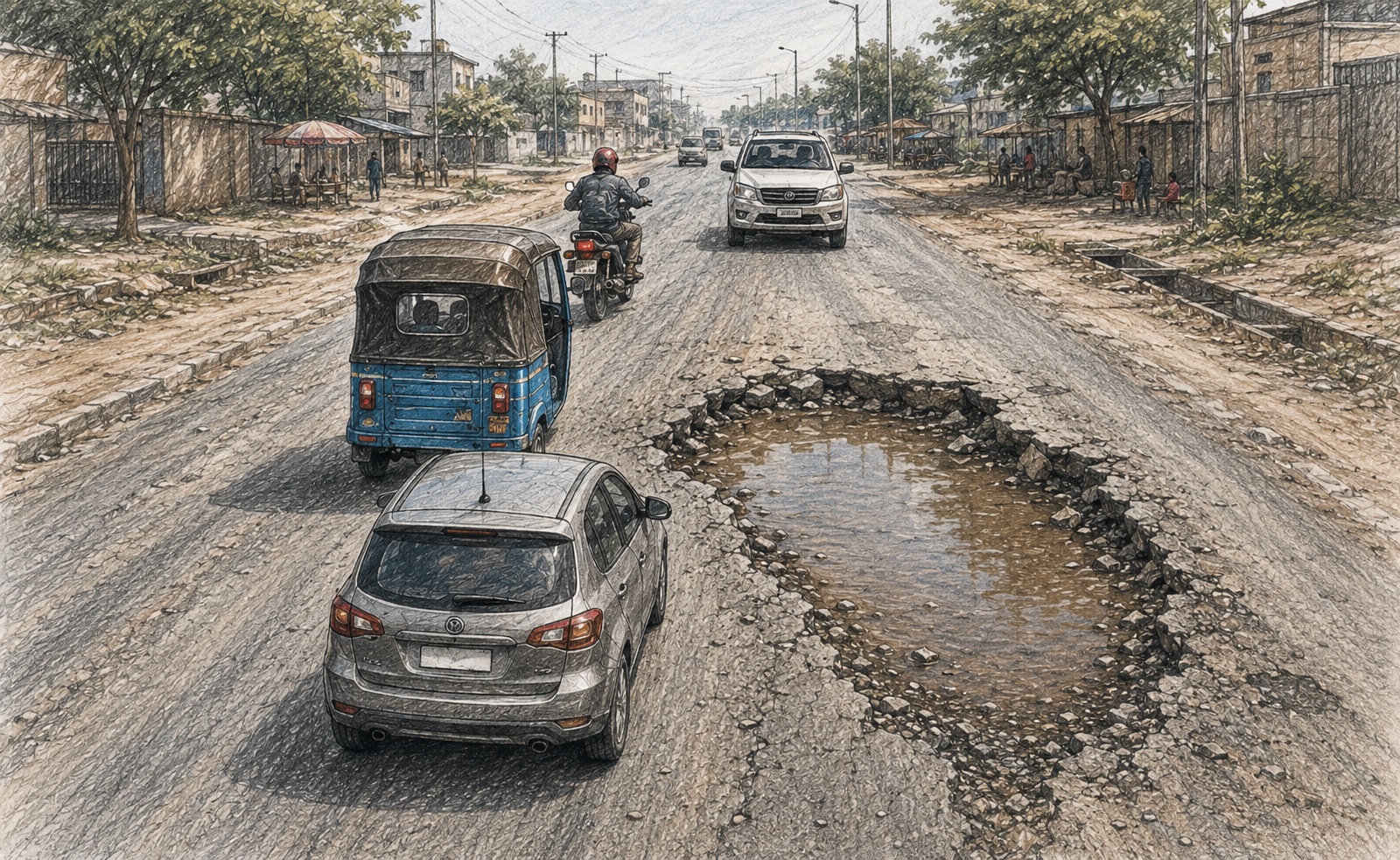
Picture this: a large pothole occupies almost the entire lane.
The car in front of us slows down and moves slightly into the opposite lane to avoid it.
At the exact same moment, a Petita decides to overtake that car.
Before the Petita can complete the maneuver, a motorcycle also decides to overtake... the Petita.
Now imagine all of this happening on a road with no center line, no overtaking markings, no warning signs, and no indication whatsoever of whether overtaking is even permitted.
Then imagine another vehicle suddenly appearing from the opposite direction.
For a few seconds, four vehicles were competing for the same piece of road. See the following image to get a clearer view of the situation
Nobody was necessarily trying to be reckless. Everyone was simply adapting to the road in front of them.
And that's precisely what scared me: the danger wasn't one bad driver.
The danger was a system that quietly encouraged everyone to make individually "reasonable" decisions that collectively became dangerous.
I honestly thought that could have been the end of my story. Thankfully, it wasn't.
But someone else may not be as lucky tomorrow.
This Doesn't Have to Cost Millions
When we talk about road infrastructure, it's easy to imagine billion-dollar highway projects.
That's not what I'm talking about.
Sometimes the biggest safety improvements are also the cheapest.
Simple lane markings, continuous center lines where overtaking is prohibited, dashed lines where it is safe, reflective paint, basic warning signs before dangerous curves, regular pothole repairs on the busiest roads, visible pedestrian crossings, you can name a few cheap things to add
In fact, the Congolese Highway Code already recognizes the importance of road markings. It specifies that road markings are used to regulate traffic, warn road users and guide drivers, while continuous center lines explicitly prohibit crossing or overtaking.
Drivers tend to follow the road that's presented to them.
Again, if the road communicates nothing ... everyone improvises
Roads Shape Behavior
One study on road traffic accidents in Lubumbashi found that speeding (32%), driver distraction (22%), overtaking (16%), and careless maneuvers (15%) were among the leading causes of crashes. The authors concluded that strengthening road traffic regulation is essential to reducing accidents.
Reading those numbers, I couldn't help thinking back to that afternoon.
How many of those "careless maneuvers" are actually people reacting to roads that force impossible choices?
How many dangerous overtakes begin because someone is avoiding a pothole?
How many head-on collisions begin with one vehicle leaving its lane simply because the lane itself is no longer usable?
I don't know.
I couldn't find data that answers those questions (now you're getting used to this lack of data thing, sorry), but I hope one day we will.
Because once we start measuring these situations, we can begin designing roads that prevent them instead of merely recording them after they've happened.
5. Restaurants
A quick question: "How do you usually find places to eat when you're new in a city?
I assume most people do what I do: open Google Maps, look for restaurants nearby, check the ratings, read a few reviews, look at the photos, and pick a place. I tried that in Lubumbashi and quickly discovered Google Maps isn't always telling you the truth in Lubumbashi - surprising for a city this important.
There are restaurants listed with opening hours and photos that simply don't exist anymore. In one case, I found a restaurant that had apparently been closed for months, while Google still showed it as open. I eventually reported it because I thought, well, someone has to tell Google.
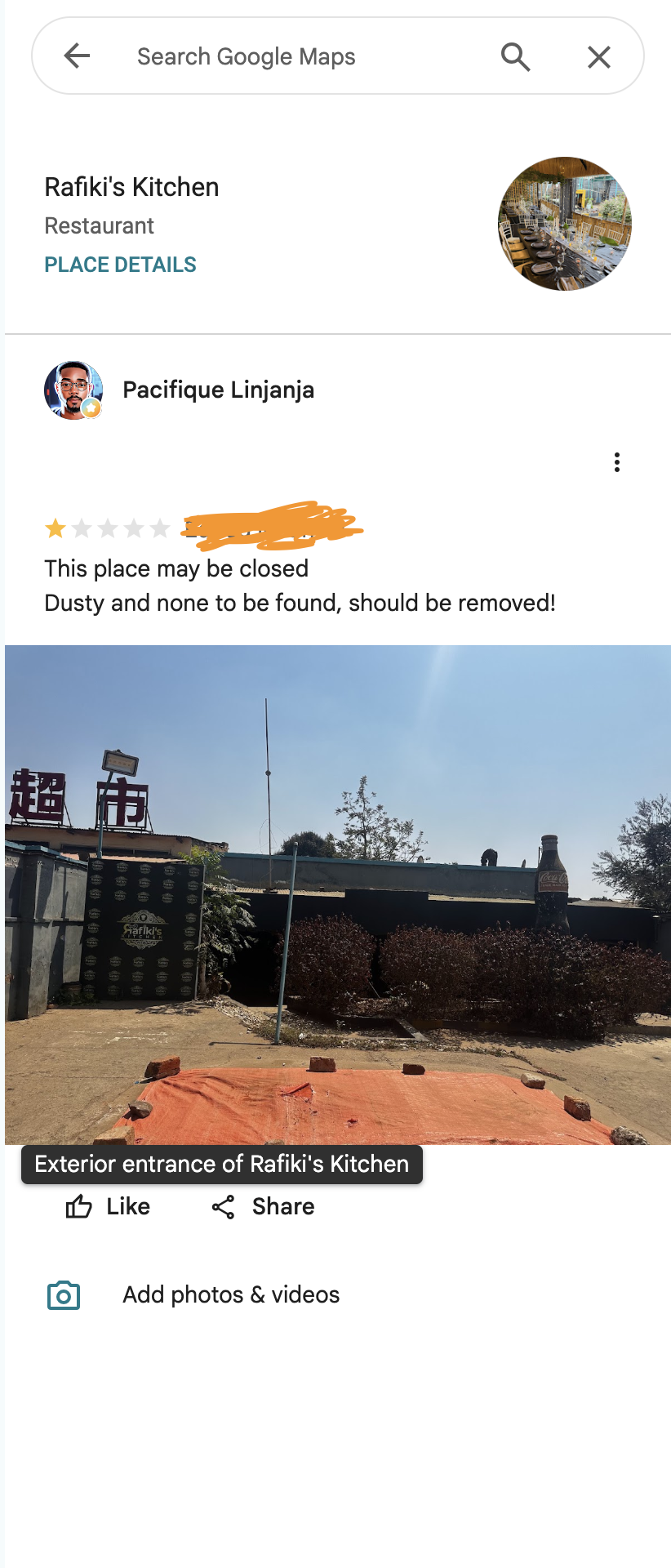
Even when the restaurant exists, the information available online can be surprisingly limited. No menu, no recent photos, no reviews, no reliable opening hours, sometimes not even a proper online presence.
So once again, you end up asking friends where you should eat. That's not necessarily terrible - recommendations from friends can actually be great - but when you're new to a city, a reliable digital layer makes life much easier.
And then there is the service itself. I've had experiences where the waiter was simply bad, the food took an unreasonable amount of time to arrive - sometimes they have to order outside their restaurant, yes, outside - the order was wrong, or the quality wasn't predictable. I can explain: you eat there on Monday, you like the food, and decide to eat there again on Wednesday; the taste? totally different. The frustrating part isn't that a restaurant can have a bad day; that happens everywhere. It's that there often isn't a meaningful feedback loop. Even when reviews exist, you sometimes wonder whether anyone actually reads them or cares. If the next customer is guaranteed to walk through the door anyway, poor service doesn't necessarily have a consequence.
This is why I think reviews matter much more than people sometimes realize. They aren't just there to help customers choose between two restaurants; they create a form of accountability. If a business knows that consistently poor service will affect its reputation and therefore its future customers, it has an incentive to improve.
I also want to be clear about something: I'm not complaining simply because some restaurants are expensive. A restaurant is free to charge whatever it wants, and customers are free to decide whether it's worth it. My problem is the price-to-quality ratio. I mean, if you're charging premium prices, there should be something premium about the experience, right? Whether that's the food, the service, the environment, cleanliness, reliability, or simply the level of care.
Again, this feels like an opportunity for relatively simple digital improvements: accurate Google Maps listings, proper menus, reliable opening hours, photos, reviews, reservations, delivery, and businesses that actually care about their online reputation. None of this is particularly futuristic. It just reduces the amount of guesswork involved in doing something as ordinary as deciding where to have dinner. And it's up to "US" customers: reviewing a place and adding a note on Google Maps takes less than 5 minutes, but can help future customers get reliable services and service providers feel accountable, somehow …
6. Service Providers
I've already talked about how nonchalant service providers are in Lubumbashi right? Now imagine this:
- You order something, and they promise a delivery on the specified date. In my case, I ordered on Thursday, payment upfront, of course - they don't joke with money
- Delivery was supposed to happen on Sunday; everything agreed, of course
- It's Sunday morning, you wake up with a message saying: "I forgot I don't work on Sunday; I will have to deliver on Monday then"
How would you react?
In my case, the delivery was mandatory for the activity I was planning to do that specific Sunday. Since there isn't any accountability mechanism, the service providers don't feel any obligation; customers have the "obligation" to pay; service providers, on the other hand … nothing, you just have to pray you met someone less problematic and someone who'd deliver.
Sunday morning, for an activity scheduled in the afternoon, you have to patch (bricoler) hoping it'll somehow work as you planned, but it never does. Again, who feels the pain? The customer. What about the service provider? He just waits for his next victim and keeps making money. If we could have ways to report cases like these, they would feel some pain, hence improve their services.
A second scenario, just to illustrate more the nonchalant attitude of service providers:
- You reserve a spot at a restaurant, with ALL your requirements
- They give you a quote, to which you only agree and pay
- This is 2 weeks before
- On the specific day, you receive a message from the management telling you: "I noticed you included this spec; unfortunately, we only offer it in the rainy season. Since we're in the dry season, it comes as an add-on, and you need to pay x amount of dollars." Note that x is ~50% of the initial price …
I mean, who does that in the real world? Didn't you see my requirements upfront? Again, we're d-day of the event, you are tired, and you either add what they asked you for, or take the bare minimum service.
Again, goes unreported; the business keeps running and doesn't feel the pain while customers keep paying it. Up to the next victim, and life goes on …
7. Mobile Money, Banks... and Consumer Rights
This chapter started as a discussion with a friend about poor internet.
It ended up making me think about something much different
Consumer rights. Do Congolese consumers have some sort of rights?
Picture this: imagine buying 5 GB of mobile data; the payment succeeds instantly, and your account is debited immediately.
Yet the network is freaky bad and unreliable, so you spend half of your day reloading pages and crossing your fingers this time it works, because the service you paid for simply isn't usable.
The surprising part isn't that this happens, but that almost nobody complains.
Instead, we've normalized carrying two or three SIM cards from different operators, hoping that one of them will work at some part of your day … and hopefully when you have that important meeting 😅
"It's just Congo." is it really? a very short law lesson:
Legally speaking, Congolese consumers are far less powerless than many of us think. The 2020 Telecommunications and ICT Law (Law No. 20/017) dedicates an entire section to consumer protection (read more here)
Among other things, Article 97 explicitly states that every consumer has the right to:
- access telecommunications services that meet standards of quality and regularity;
- freely choose their service provider;
- receive clear information about pricing and fees;
- file complaints with the regulator (ARPTC);
- receive a response to those complaints; and
- receive compensation for damages resulting from violations of their rights.
Please read that last point again
Compensation.
That word rarely appears in conversations about internet or mobile operators in Congo. Yet it's right there in the law.
The law also requires operators to clearly inform consumers about service quality, tariffs, privacy protections and any measures affecting their service.
In other words, the relationship between a telecom company and its customers isn't supposed to be based on goodwill.
It's contractual → if I pay for a product, I'm entitled to receive that product under acceptable conditions.
If I don't, there are legal mechanisms that should protect me. At least on paper …
A lawyer's perspective
I discussed this section with Julien Mulinga, a Congolese lawyer and masters degree holder, and his perspective helped me understand the distinction between what we casually group together as "bad network" and the different legal regimes behind these services. His point was simple and, honestly, quite striking: "Le droit congolais ne nous considère pas comme des mendiants du réseau, mais comme des créanciers d'un service." In other words, when we pay for a telecommunications service, we are not asking for a favour. We are customers with rights, and the law already provides mechanisms for complaints and remedies. He also pointed out that telecommunications services fall under the telecoms framework and ARPTC, while mobile money and banking services are governed by the financial-services framework supervised by the Banque Centrale du Congo. The BCC itself lists Instruction No. 24 for electronic money and Instruction No. 39 for customer complaints among the applicable financial-services rules.
Julien also highlighted a practical point that deserves more attention: if you pay for a specific telecommunications service and the service is not delivered as promised, this is not simply something consumers have to "accept." He referenced the contractual obligations under Congolese law and the possibility of sanctions and compensation already provided for in the existing framework. I have not independently verified every part of his legal interpretation, so I am presenting this paragraph as his legal perspective, rather than pretending this article is a legal opinion.
The gap between law and culture
The bigger issue, in my opinion, isn't that the law is missing. It's that we've collectively stopped expecting it to matter.
When Vodacom isn't working...
...we switch to Airtel.
When Airtel slows down...
...we switch to Orange.
When Orange struggles...
...we tether from Africell
Nobody asks for a refund. Nobody asks whether the advertised service was actually delivered. Nobody even considers filing a complaint, at the end of the day … "connection mu congo inakuwaka tuh mubaya (network in DRC is just bad)."
We've quietly accepted that paying for a service and receiving that service are two completely separate events, and operators don't feel any obligation or any pain in their business; they'll still pay anyway
That normalization should concern us more than the network outage itself. Because when citizens stop expecting accountability → companies stop feeling accountable → quality stops improving.
The same frustration exists with banks and Mobile Money, but there is an important distinction: these services do not all fall under exactly the same regulatory framework as telecommunications. The Banque Centrale du Congo oversees the financial-services and payment-system side, including electronic money, payment systems and consumer protection. It lists Instruction No. 24 on electronic money and Instruction No. 39 on customer complaints, alongside the broader legal framework for payment systems.
And then there are the ATMs. From my own experience, it can feel like a lottery: sometimes the machine is closed, sometimes there is no cash, sometimes there is a network error, and sometimes—miraculously—it just works. That's an observation from my experience, not a statistical measurement, but it illustrates the same underlying problem: customers end up carrying the burden of systems that are supposed to serve them.
8. Dust

Before making this sound like a complaint about everything, let me say something I genuinely liked about Lubumbashi: a surprisingly large number of roads are paved. In a country where proper goudron is still relatively rare, especially outside the main urban centres, I was actually impressed by how much of Lubumbashi has macadam. Even when you move into the quartiers, you can find quite a few paved roads and areas that are properly goudronnés. Compared with many other cities in Congo, that's something I really appreciated.
The irony is that once you leave those paved roads, the city's soil makes its presence very clear. The dust can be intense, especially during the dry season. And honestly, this is partly an unlucky situation for Lubumbashi: the nature of the soil means that unpaved roads can become extremely dusty, so not all of this is simply a matter of poor infrastructure. Still, there are things that could make it more manageable. Regularly watering some of the busiest unpaved roads, particularly in the quartiers, could help reduce the amount of dust people breathe and carry into their homes and businesses. I know that sounds easier than it actually is, especially during the dry season when water itself becomes a resource that needs to be managed carefully, but targeted maintenance could still make a noticeable difference.
I also liked seeing roads being swept in the central parts of town. It's a small detail, but it makes a difference: clean streets make a city feel cared for. I'd love to see that kind of maintenance expanded to more neighbourhoods. Beyond keeping the city cleaner, it could also create a lot of practical jobs for people in lower- and middle-income communities if street cleaning and basic urban maintenance were organized as regular municipal services.
So, yes, the dust tested my patience. But I don't want to overlook the positive side: Lubumbashi has already done something that many Congolese cities still struggle with by putting goudron on a significant number of its roads. The opportunity now is less about starting from zero and more about maintaining what exists, extending it where possible, and finding practical ways to make the unpaved parts of the city more livable.
9. The Hidden Cost of Friction
This article isn't really about roads, restaurants or the internet. It's about friction: thousands of small inefficiencies that quietly steal time, money, energy and peace of mind. Individually they're manageable; collectively, they become a tax on everyday life.
A few words for future visitors
If you're coming to Lubumbashi for a few days, you'll probably have a very different experience from someone staying for several weeks. For a short visit, the city can be quite pleasant, especially if you have friends or someone local to guide you.
For a longer stay, however, the little frictions start adding up: finding accommodation, moving around, dealing with cash, internet reliability, road conditions, and simply figuring out how things work.
That's ultimately what this article is about.
Lubumbashi isn't necessarily difficult to visit. It can be surprisingly difficult to live in.
And perhaps that's an important distinction for anyone planning to spend some time here.
10. Complaining Is Easy. Building Better Systems Is Hard.
I don't believe Lubumbashi needs miracles. Nor do I think it should copy another city overnight.
What it needs is better systems.
The encouraging part is that many of the frustrations described throughout this article have already been tackled elsewhere on the continent.
Not perfectly.
But successfully enough to make everyday life noticeably easier.
The lesson isn't that Rwanda or Kenya are flawless.
The lesson is that they decided certain inconveniences were no longer acceptable—and built systems around that belief.
Transportation
Instead of negotiating every trip, ride-hailing platforms introduced predictable pricing, driver identification, trip history, and customer ratings.
Whether you use Uber, Bolt, Yego or Move, the experience is built around one simple promise: you know who is picking you up, how much you'll pay, and how to complain if something goes wrong. That doesn't eliminate bad drivers; it creates accountability.
There is also an interesting local example from Goma, where residents in some neighbourhoods have organized and contributed directly to paving their own avenues, with local authorities providing support or coordination. On Avenue du Lac in Katindo, residents reportedly financed about 12,548 m² of volcanic-stone paving, while another community-led project in Kyeshero II combined residents' contributions with a request for provincial support.
I find this particularly interesting because it suggests another possible model for cities like Lubumbashi: citizens can participate in improving their own neighbourhoods, while government provides standards, technical supervision, coordination and, where possible, matching funds. Goma has also used labour-intensive paving programmes that created temporary employment while improving roads, showing that road infrastructure can be both a mobility project and a jobs programme.
Digital Payments
Cash still has its place.
But it shouldn't be the default because digital payments are inconvenient.
One thing that shocked me in Lubumbashi was how often businesses either:
- refused digital payments altogether;
- asked customers to pay an extra "withdrawal fee" simply because they wanted to pay via Mobile Money;
- or accepted Mobile Money only if the customer covered transaction costs.
Imagine paying for a meal with cash.
Nobody asks you to pay extra because the restaurant had to count the banknotes.
Yet paying digitally somehow becomes the customer's problem.
Digital payments should reduce friction—not create new fees.
Countries like Rwanda have invested heavily in interoperable digital payment systems precisely to make electronic payments simple, immediate and accepted almost everywhere.
Cashless economies don't emerge because people suddenly stop liking cash.
They emerge because digital payments become easier than cash.
Property Rentals
Finding an apartment shouldn't require joining fifteen Facebook groups, calling five brokers and hoping somebody knows somebody.
Transparent online listings.
Verified landlords.
Clear prices.
Availability calendars.
None of this is revolutionary.
It already exists.
Technology didn't solve the housing market.
It simply removed unnecessary uncertainty.
Restaurants and Service Providers
Imagine searching for a restaurant and immediately finding accurate opening hours, current prices, reviews, photos, reservations and delivery options. Now imagine plumbers, electricians, drivers, mechanics and cleaning companies competing through the same kind of reputation system rather than simply through who knows whom. Customer reviews don't magically create better businesses; they make poor service expensive.
Public Administration
Nobody enjoys paperwork.
But digitizing public services doesn't only save citizens time.
It reduces opportunities for corruption.
Every physical interaction that becomes an online process is one less opportunity for arbitrary decisions, unnecessary delays or informal payments.
A receipt leaves a trail.
Cash often doesn't.
Digital processes are easier to audit than conversations.
That alone changes incentives.
Consumer Protection
Perhaps the simplest reform isn't creating new laws.
It's enforcing the ones we already have.
Imagine if mobile operators consistently refunded customers when advertised service levels weren't delivered.
Imagine if recurring network failures resulted in public reports, measurable penalties or mandatory compensation.
Consumers would regain confidence.
Operators would compete on quality rather than marketing.
And everyone would win.
None of This Is Science Fiction
Notice something about these examples: none requires artificial intelligence, billion-dollar infrastructure projects or some revolutionary invention. Most of the technology already exists, and some of the legal mechanisms already exist too. What is missing is often consistency: enforcement, institutional coordination, maintenance and political will.
Lubumbashi-and honestly much of the DRC-doesn't lack ideas.
It doesn't lack talent either, I've met talented individuals like Wilfried Musanzi (musanzi.me - software engineer and looking for opportunities, local or remote) and manyyyyyy more I've known long ago.
It often lacks systems that reward doing the ordinary things consistently well.
If there's one idea I'd like readers to remember, it's this:
Making life easier is economic development.
Every hour people don't spend negotiating taxi fares...
...searching for an ATM...
...paying unnecessary Mobile Money fees...
...switching between SIM cards...
...avoiding potholes...
...or repeating paperwork...
is another hour they can spend building businesses, studying, creating jobs or simply enjoying life.
Sometimes the biggest reforms aren't the spectacular ones.
They're the ones that make an ordinary Tuesday afternoon feel... ordinary.
11. The People Who Made My Stay Better
One thing I don't want this article to overlook is the people.
Cities are more than infrastructure.
They're the people you meet.
The friends who help you settle in.
The stranger who gives directions.
The waiter who remembers your order.
The driver who becomes someone you trust.
Despite everything I've written above, I was fortunate enough to meet people who genuinely made my stay enjoyable — a professional driver who made getting around Lubumbashi remarkably easy, and a few restaurants and businesses that exceeded my expectations.
Constructive criticism matters.
But recognition matters just as much.
12. Final Thoughts
One thing I've learned—not only in Lubumbashi, but across many Congolese cities—is that human beings have an incredible ability to adapt.
It's one of our greatest strengths.
It's also one of our greatest weaknesses.
When something happens every single day, our brains slowly stop questioning it.
Power cuts become normal.
Negotiating every taxi ride becomes normal.
Driving around potholes becomes normal.
Buying internet from three different operators becomes normal.
Paying for data you can't reliably use becomes normal.
Being stopped multiple times on the same road becomes normal.
Eventually, we stop asking whether these things should happen at all.
Instead, we justify them.
"Everyone rides Petitas."
"That's just how things work."
"Even the governor has bad internet."
"This is Congo."
Maybe. But I don't believe something becomes legitimate simply because millions of people have learned to live with it.
Normality isn't determined by frequency; it's determined by whether something deserves to be accepted.
If ten million people lose an hour every day because a system is inefficient, that doesn't make the inefficiency acceptable. It simply means ten million people deserve something better. That's 10 million hours that would have been spent developing our country and moving the economy.
We Congolese are remarkably resilient. We've learned to adapt, improvise, and keep moving forward despite systems that too often work against us.
But resilience should never become an excuse for lowering our expectations.
We deserve cities where convenience isn't a luxury.
Where paying for a service means actually receiving that service.
Where roads don't require survival skills.
Where ordinary things are... ordinary.
Because progress begins the day we stop confusing adaptation with satisfaction.